


A New – and Old – China Human Rights Agenda at the United Nations
Comments Off on A New – and Old – China Human Rights Agenda at the United Nations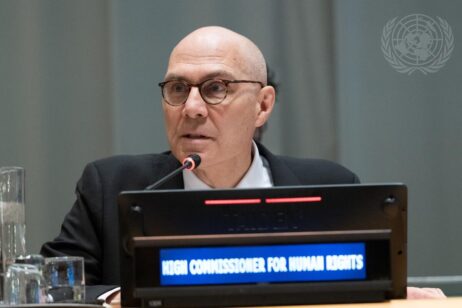
By Sophie Richardson
Originally published by The Diplomat on July 29, 2026
Why did China support the re-election of Volker Turk as U.N. High Commissioner for Human Rights?
https://thediplomat.com/2026/07/a-new-and-old-china-human-rights-agenda-at-the-united-nations
Credit: UN Photo/Evan Schneider
Volker Turk, the United Nations High Commissioner for Human Rights, has won re-election to hold that post for another four years. Several governments objected to the process; 144 others, including China, voted in support of a second term for him.
Over the past four years Chinese authorities have deepened repression. The Chinese government inflicts collective punishment on the families of defenders and prisoners of conscience and has a disturbing track record of defenders dying in detention. Its enthusiasm for transnational repression – an effort to silence critics of the Chinese government outside the country – is growing, and it increasingly thwarts human rights scrutiny by U.N. bodies. In fact, the Chinese government ranks high among the states targeting human rights defenders for engaging with U.N. human rights mechanisms.
While Turk has offered up occasional critiques of Beijing’s human rights abuses, ranging from calling for abusive laws to be repealed and condemning the treatment of individual prisoners of conscience, his efforts have caused Beijing no real discomfort, and not kept pace with that regime’s violations.
Just weeks before Turk formally took up the role of High Commissioner in October 2022, the Office of the High Commissioner for Human Rights (OHCHR) published a landmark report alleging that Chinese government policies toward Uyghurs and other Turkic communities entailed mass arbitrary detention, torture, and family separations. The report concluded that the Chinese government’s actions “may… constitute crimes against humanity.”
Pressed by governments, journalists, and activists since then, Turk has said that there “is no crack of light” between him and the report’s findings. Yet over the past four years, he and his senior colleagues opted to pursue the diplomatic cul-de-sac of dialogues with those responsible for the abuses: Chinese government officials. He has rarely met with the victims and survivors of Beijing’s abuses.
Turk cannot now say that he needs time to cycle through the standard diplomatic playbook with Beijing – those efforts do not appear to have yielded results, allowing further human rights deteriorations to go unaddressed. If in his second term he wants to make meaningful progress toward redressing deepening repression inside China – and halting Chinese government abuses in other countries – he should prioritize four steps, all of them immediately achievable.
First, when the U.N. Human Rights Council – the world’s flagship political human rights body – goes into session in September, Turk should seize the opportunity to brief member states on what he has tried to achieve for victims and survivors since that September 2022 report. He should explain why those efforts have faltered, and, most importantly, what he plans to do instead, such as updating the findings of the report, and interviewing witnesses. Nothing prohibits him from taking such actions, and doing so would at least rob Chinese diplomats of the opportunity to brag – as they do in the halls of the Palais des Nations – about having shut down discussion about their grotesque abuses.
Second, Turk could reallocate a resource over which he has a great deal of control: time. He should spend as much time with the victims and survivors of Beijing’s abuses as he has spent with the perpetrators. Not only should he hear their horror stories, but he should be seen to have met with them. Beijing is known for threatening officials not to meet people or attend events representing ideas it does not like, often labeling them anti-China or “terrorists.” Too many governments take this threat seriously, and the result is to further disempower people with legitimate positions on human rights – particularly victims.
Third, Turk should set out ambitious agendas to address alleged Chinese government crimes against humanity, including articulating legal pathways to accountability. But he should also directly address the concerns repeatedly set out by U.N. human rights experts, known as “special procedures,” who have for six years sounded alarms about Beijing’s non-compliance with and manipulation of its obligations under international human rights law. They have asked for the kind of help leadership requires: a special session at the HRC on China, the appointment of an expert specifically on China, greater attention to Beijing’s growing hostility toward U.N. human rights mechanisms.
Finally, Turk can help deny Beijing with “blue washing” its reputation through U.N. human rights reviews. Chinese diplomats shrilly insist there are no human rights abuses in the country. The best response to this position? Relentless public confrontation using facts and specifics: that allegations of crimes against humanity have also come from U.N. experts on arbitrary detention. That Beijing’s new “Ethnic Unity and Progress Law,” which is diametrically opposed to the government’s international obligations against discrimination, is another profound threat to the future of Tibetans, Uyghurs, and so many other groups already at risk of state-sponsored identity erasure. Nearly all 300 of the human rights lawyers detained, disbarred, or disappeared across China in 2015 have been unable to resume their essential – and legally protected – work.
Turk has a unique opportunity – he knows the job, the institution, the geopolitics, and now has four full years to put that knowledge to good use. He is demonstrably comfortable challenging some permanent members of the U.N. Security Council, particularly Russia and the United States. His office has demonstrated its capacity to document Beijing’s human rights crimes; other U.N. human rights bodies regularly provide strong evidence of other abuses. He needs to understand the risks it takes for victims from China to reach out to his office, and how unique a responsibility he has speaking with them and on their behalf.
The only outstanding question: will he put his new term to use in service of victims and survivors of Beijing’s abuses, and of accountability? That would be an outstanding legacy. Without such leadership the United Nations will become progressively less relevant on human rights – exactly the outcome several powerful states would like to see.
Guest Author
Sophie Richardson
Sophie Richardson is the co-executive director of the Network of Chinese Human Rights Defenders.