


China: Labor Advocate Feng Rui Interrogated While Ill
Comments Off on China: Labor Advocate Feng Rui Interrogated While Ill
Questioned up to three times a day even when too sick to walk
(Network of Chinese Human Rights Defenders — October 21, 2026) Police in Guangzhou have held labor rights advocate Feng Rui, known online as Xiao Wu, since September 14 on suspicion of “picking quarrels and provoking trouble,” according to the Chinese-language site Rights Defense Network (RDN).
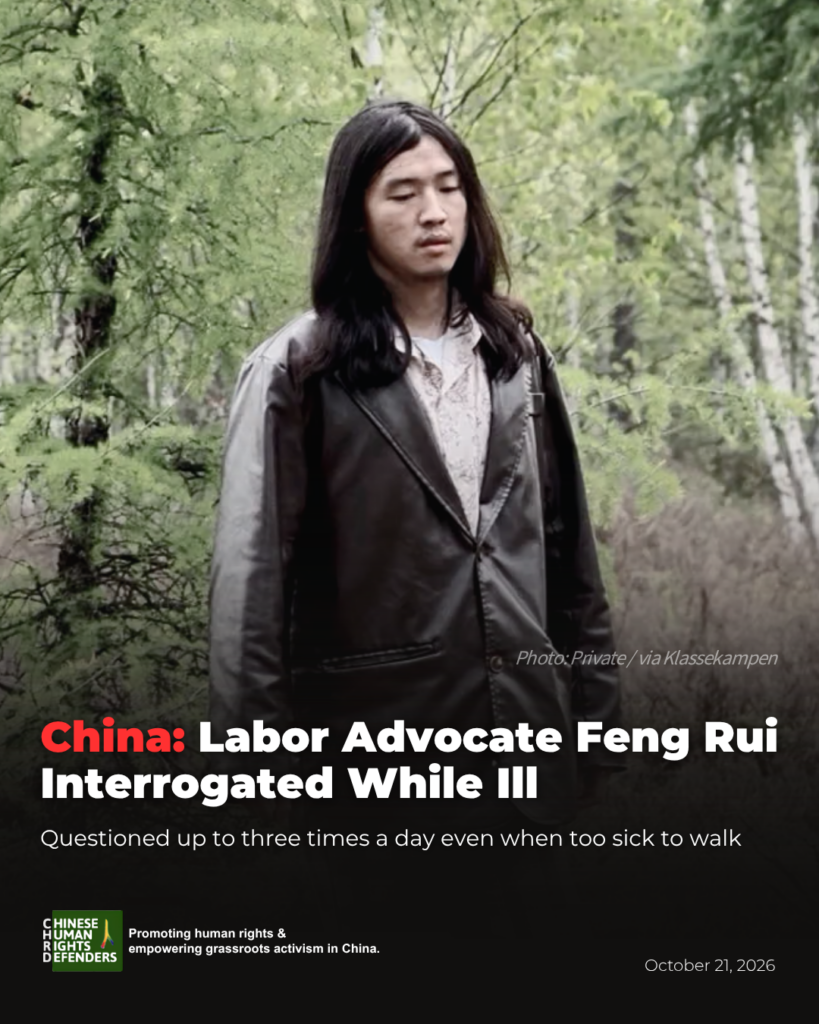
Feng is being held at the Yuexiu District Detention Center in Guangzhou, where he has reportedly been interrogated nearly every day—sometimes up to three times a day—since September 17. Even when Feng was vomiting, suffering from diarrhea, and so weak he had to be moved in a wheelchair, police continued their interrogations, and he has reportedly missed meals as a result. Feng also has a cervical spine condition that long questioning sessions are likely to aggravate.
RDN reported that Feng runs a WeChat public account that, since 2021, has published an annual review of labor rights incidents compiled from public information. The reviews included information about pay cuts and wage arrears, gig and platform workers, migrant workers, social insurance, workers with disabilities and illnesses, and workplace accidents. The WeChat account has not been updated since Feng’s detention.
Interrogating a detainee who is sick, exhausted, and not adequately nourished raises concerns about torture or other ill-treatment, and about the reliability of any statements obtained. Under the United Nations (UN) Convention against Torture, which China has ratified, evidence obtained through torture must not be used in any proceedings. China’s own Criminal Procedure Law strictly prohibits extracting confessions through torture (Article 52) and requires that confessions obtained by such illegal methods be excluded as evidence (Article 56). CHRD research—published just two days after Feng’s detention—shows that the most common form of torture inflicted on prisoners of conscience is denial of access to adequate medical care.
CHRD’s May 2025 analysis of arbitrary detention found that “picking quarrels and provoking trouble” is among the charges Chinese authorities use most often against prisoners of conscience; in September 2025 the UN High Commissioner for Human Rights called for its repeal, arguing that the charge is vague and vulnerable to abuse. Chinese authorities also used this problematic charge in another case, when Shandong human rights defender and Buddhist monk Zhang Chao was sentenced to one year and two months in prison following a closed-door trial on September 23. In his case, the alleged “picking quarrels and provoking trouble” consisted of Zhang photographing the area outside Tiananmen Square on June 4, 2026, and posting the images with a memorial poem to his WeChat friends.
When the Chinese Communist Party’s Central Committee meets in Beijing fro, October 26 to 29, 2026, for its Fifth Plenum, which state media say will be devoted to “full and rigorous Party self-governance,” it should commit to ending the government’s systematic use of arbitrary detention against prisoners of conscience. The UN Working Group on Arbitrary Detention has repeatedly warned that widespread or systematic imprisonment in violation of international law, as practiced in China, may constitute crimes against humanity.
Chinese authorities should release Feng Rui immediately and unconditionally and drop all charges against him. Pending his release, they should end the coercive interrogations, give him proper medical care and food, and guarantee his access to lawyers chosen by him or his family. They should also free Zhang Chao and all other prisoners of conscience.
For more information, please contact:
Sophie Richardson, Co-Executive Director, Chinese Human Rights Defenders, sophierichardson[at]nchrd.org, +1 917 721 7473
Shane Yi, Researcher, Chinese Human Rights Defenders, shaneyi[at]nchrd.org