


China: Authorities Flout International Law, Enabling Child Labor
Comments Off on China: Authorities Flout International Law, Enabling Child Labor
(中文版本)
New research shows illegal child employment, hazardous work conditions in mandatory internships
(Network of Chinese Human Rights Defenders—May 21, 2026) The Chinese government, schools, and companies are failing to protect some children under 18 from hazardous work conditions and children under 16 from illegal employment, the Network of Chinese Human Rights Defenders (CHRD) said today in a new report. Despite domestic legislation and China’s ratification of international treaties, child labor abuses persist across industries and regions throughout the country.
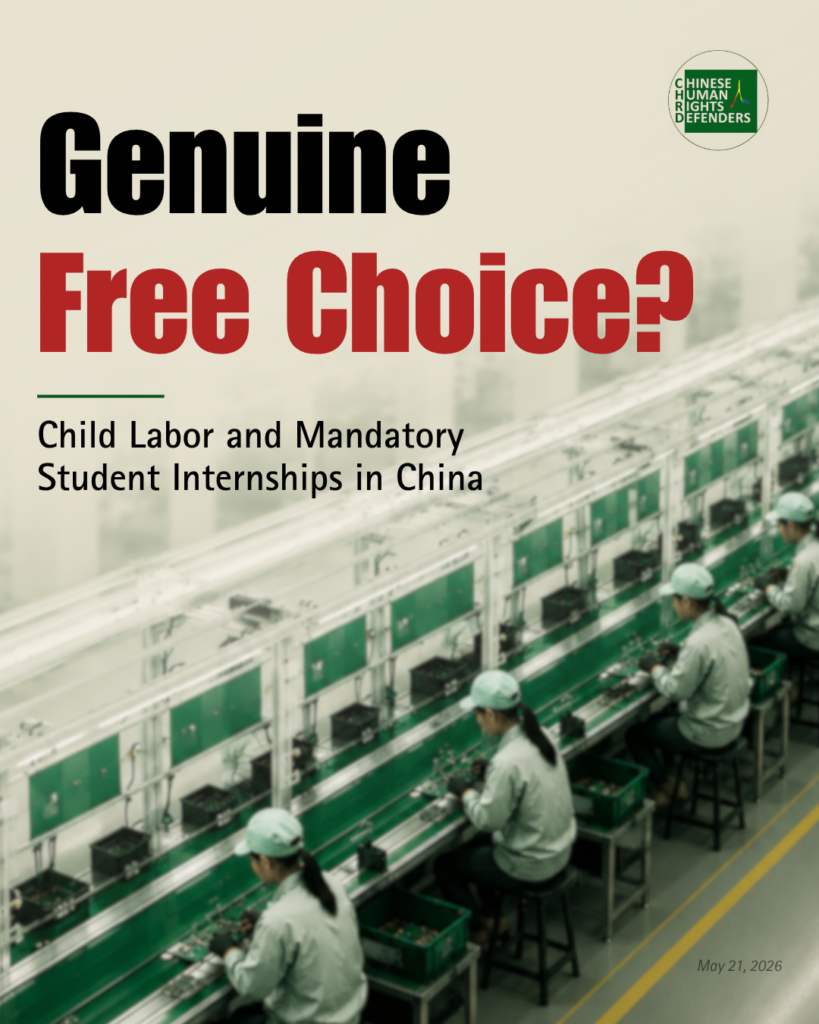
CHRD’s 46-page analysis, Genuine Free Choice? Child Labor and Mandatory Student Internships in China, examines labor rights violations in internship programs that are mandatory for about four million secondary vocational school students each year, and illegal hiring of children under 16. The report amplifies longstanding concerns expressed by United Nations (UN) human rights experts, and hopes to inform scrutiny of China’s child labor violations by the UN Committee on the Rights of the Child and the International Labour Organization (ILO).
“Child labor persists because authorities fail to consistently enforce protections, putting children at risk,” said Shane Yi, researcher at CHRD. “Instead of enjoying their rights to education, health, and development, some children are working long hours in unsafe or inappropriate conditions, sometimes with grim disregard for their wellbeing.”
CHRD drew on government penalty notices, online databases, court documents, and Chinese-language media reports, among other sources, documenting rights abuses in 11 provinces between 2019 and 2025. Some vocational students’ internships involved working 10–12-hour shifts—including night work—performing tasks unrelated to their studies. Other internships put students at risk of physical harm. Three student interns died—two by suicide, one after being denied adequate medical care—and another harmed himself; all had expressed distress to teachers or managers. Schools and companies engaged intermediary agencies to arrange internships while taking “commissions” from student wages despite explicit legal prohibitions on both practices.
CHRD also found that companies across manufacturing, entertainment, and service sectors hired children as young as 13. More than a dozen records of government penalty between 2019 and 2025 in six provinces show repeated child labor violations. In July 2024 alone, the local government in Dongguan, Guangdong Province, issued 39 administrative penalty notices to companies related to child labor.
Although authorities’ imposition of penalties, and state media coverage, can be considered limited forms of accountability, they rest on victims’ willingness to report violations and endure possible reprisals. That risk, which some families do not want to take, means that the true scale of these violations likely exceeds what is publicly reported or officially recorded. Corporate compliance with legal requirements, Environmental, Social, and Governance (ESG) commitments, and human rights due diligence standards is inconsistent, as shown by CHRD’s correspondence with three Chinese firms and some of their international customers.
The violations documented in this report call into question Chinese authorities’ willingness to enforce domestic laws, including the Law on the Protection of Minors and the Regulations on the Management of Vocational School Student Internships, to protect children. The violations also reflect disdain for the human rights guaranteed through the Chinese government’s ratifications of the Convention on the Rights of the Child (CRC) and ILO conventions.
To end abuses and protect students, CHRD urges the immediate suspension of mandatory internships as secondary vocational school graduation requirements until the human rights of children in these programs can be guaranteed. Companies across China involved in vocational internship programs should undertake and publish annual human rights due diligence reviews to identify harms committed or exacerbated by their operations and take concrete steps to remedy them.
China’s obligations under the CRC are periodically scrutinized by the Committee on the Rights of the Child but the last review was in 2013; its subsequent report, due in 2019, was not submitted until 2023. The funding crisis straining the UN system has further delayed scheduling a new review, leaving China without formal examination for over a decade. Given the urgency of child labor concerns and harmful working conditions for minors in mandatory internship programs, the Committee on the Rights of the Child should pursue alternative monitoring measures if a review cannot be held this year, including issuing targeted requests for information, and increasing pressure where non-compliance persists.
“Children need the support of international human rights bodies to ensure meaningful enforcement of legal protections across China,” Yi said. “Children should not pay the price for government intransigence.”
(Download and read the Full Report Here)
For more information, please contact:
Sophie Richardson, Co-Executive Director, Chinese Human Rights Defenders,
sophierichardson[at]nchrd.org, +1 917 721 7473 (English)
Angeli Datt, Research and Advocacy Coordinator, Chinese Human Rights Defenders, angelidatt[at]nchrd.org, +1 934 444 6155 (English)
Shane Yi, Researcher, Chinese Human Rights Defenders, shaneyi[at]nchrd.org (English & Mandarin)