


China: Repression Deepens as Abuses Go Unaddressed at UN
Comments Off on China: Repression Deepens as Abuses Go Unaddressed at UN
Four years after landmark report, Human Rights Council should act on mass violations
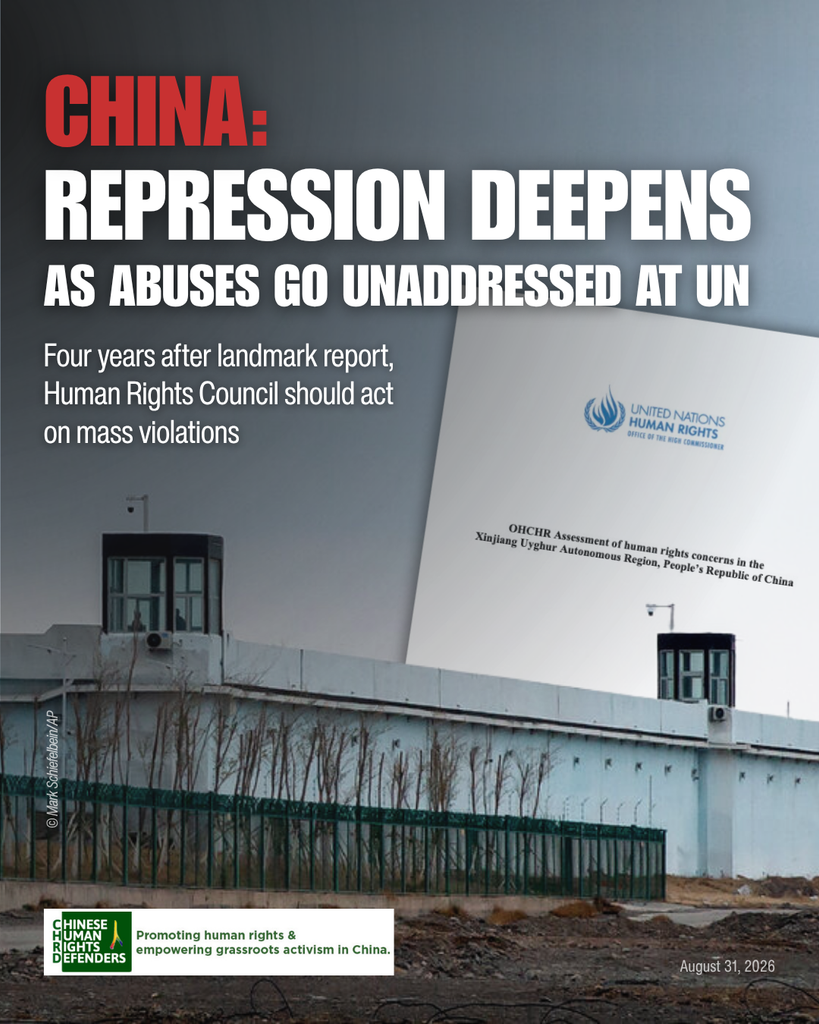
(Network of Chinese Human Rights Defenders — August 31, 2026) — The United Nations and member states can reverse deepening Chinese government impunity for human rights violations by addressing allegations of crimes against humanity targeting Uyghurs, CHRD said today. August 31 marks the fourth anniversary of a landmark UN report on those and other abuses, yet Chinese officials have faced no serious scrutiny at the UN. The next UN Human Rights Council session begins September 7, 2026.
“The Chinese government’s record of human rights violations gets longer each year, partly because it pays no real price for abuses,” said Sophie Richardson, Co-Executive Director at CHRD. “The High Commissioner, the Human Rights Council, and member states can change that by demanding answers from Beijing and mapping out investigative strategies.”
On August 31, 2022–the last day of former High Commissioner for Human Rights Michelle Bachelet’s term–the Office of the High Commissioner for Human Rights (OHCHR) released its long-delayed analysis, “OHCHR Assessment of human rights concerns in the Xinjiang Uyghur Autonomous Region, People’s Republic of China.” That report concluded that patterns of arbitrary and discriminatory detention “may constitute international crimes, in particular crimes against humanity.” It remains the most authoritative UN documentation of these abuses, supplemented by reporting from other UN human rights experts, working groups, and treaty bodies.
Chinese authorities continue to commit widespread abuses across the Uyghur region. CHRD’s research, covering cases from 2019 to 2024, finds that prisoners of conscience from minoritized communities remain disproportionately represented among those wrongfully detained; the average prison sentence for Uyghurs and Kazakhs in the region is 15 years, more than double the national average. The Uyghur Transitional Justice Database counts over 12,600 cases classified as “missing,” and Xinjiang Victims Database documents more than 100,000 cases overall. A May 2026 Financial Times investigation, based on analysis of satellite imagery, government documents, local media, and eyewitness accounts, found that the region’s detention facilities can hold approximately 627,000 people, “making it the world’s largest detention system relative to population.”
In 2025, a Chinese Foreign Ministry spokesperson maintained that Xinjiang “enjoys social stability, economic growth and ethnic solidarity, and the local people now live a better life”—yet heavily restricts access to the region for independent human rights investigations.
Chinese authorities also continue to silence criticism outside the country. On August 24, 2026, the Chinese embassy in Buenos Aires, Argentina pressured the city legislature into canceling an event featuring Uyghur speakers, forcing organizers to relocate on short notice. Citizen Lab, a research group based at the University of Toronto, has tracked a Chinese government-linked phishing and impersonation campaign since April 2025 targeting Uyghur, Tibetan, Taiwanese, and Hong Kong diaspora activists and journalists.
In the four years since the assessment’s release, the Chinese government has thwarted various UN attempts to scrutinize its human rights record. It dismissed the OHCHR report as “completely illegal and void,” fails to submit credible reports on key human rights issues including torture, commits reprisals against human rights defenders who seek to engage UN human rights bodies, and inflicts collective punishment on defenders’ family members.
In that same period, the Human Rights Council has not acted on repeated calls — from UN Special Procedures experts, treaty bodies, and civil society — to have a dedicated discussion about or establish a monitoring mechanism on the Chinese government’s human rights record and non-compliance with UN human rights mechanisms. The High Commissioner for Human Rights has yet to update the Council on what progress his office has made with the Chinese government through a dialogue to discuss the report’s recommendations.
CHRD urges the High Commissioner, who in July 2026 was reelected for a second term, to use the forthcoming session to publicly detail implementation of the 2022 report recommendations, including obstacles imposed by Chinese authorities. The High Commissioner should also outline plans for assistance to victims and survivors, evidence collection, and options for investigative efforts. CHRD also encourages concerned governments to ask questions of the High Commissioner about this follow up, and to request that the Chinese delegation to allow access to the Uyghur region for independent UN experts.
“Chinese diplomats consider themselves successful in evading UN human rights scrutiny,” Richardson said. “UN bodies and member states should aspire to succeed in holding Beijing to account before its list of victims grows still longer.”
For more information, please contact:
Sophie Richardson, Co-Executive Director, Chinese Human Rights Defenders,
sophierichardson[at]nchrd.org, +1 917 721 7473
Shane Yi, Researcher, Chinese Human Rights Defenders, shaneyi[at]nchrd.org