


China: New “Ethnic Unity” Law Legalizes Discrimination, Repression
Comments Off on China: New “Ethnic Unity” Law Legalizes Discrimination, Repression
Latest restrictions further curb language and culture, enable transnational repression
(Network of Chinese Human Rights Defenders—June 25, 2026) The Chinese government’s new “ethnic unity” legislation, which comes into effect on July 1, permits violations of human rights, particularly ethnic minorities’ rights to culture and way of life. The new legislation, which was adopted by the National People’s Congress in March 2026, contravenes domestic law, including the Constitution, and obligations under the International Convention on the Elimination of All Forms of Racial Discrimination (CERD) and the Convention on the Rights of the Child (CRC).
“This law criminalizes aspects of people’s and communities’ identities the authorities deem problematic,” said Shane Yi, researcher at CHRD. “This approach has nothing to do with unity, and everything to do with punishing legally protected characteristics.”
While authorities assert that the Law on Promoting Ethnic Unity and Progress is intended to enhance “social cohesion,” its provisions do the opposite—reinforcing restrictions on “freedoms of language, education, practice of religion, culture, expression and assembly, and penalizing the peaceful exercise of minority rights,” as Volker Türk, United Nations High Commissioner for Human Rights, warned on June 15 at the Human Rights Council. He has called for the law to be repealed.
In April, eight UN human rights experts raised concerns that several provisions of the law are ambiguous, open to broad interpretation, and susceptible to misuse. They also identified specific human rights—including the rights to development, free speech, education, housing, and religion, among others—guaranteed under international law but jeopardized by the “ethnic unity” law.
CHRD’s Prisoners of Conscience (PoC) database and prior research document years of official persecution of rights advocates, particularly of those working on behalf of minoritized ethnic and religious communities. A March 2025 report showed that individuals from minoritized groups are overrepresented relative to the national population and receive lengthier sentences upon conviction: Tibetans, who make up just 0.5 percent of the population, account for over eight percent of PoCs in the database. The average prison sentence for Uyghurs and Kazakhs in the Uyghur region was 15 years—more than double the national average—based on the study of 1,422 PoCs between 2019 and 2024.
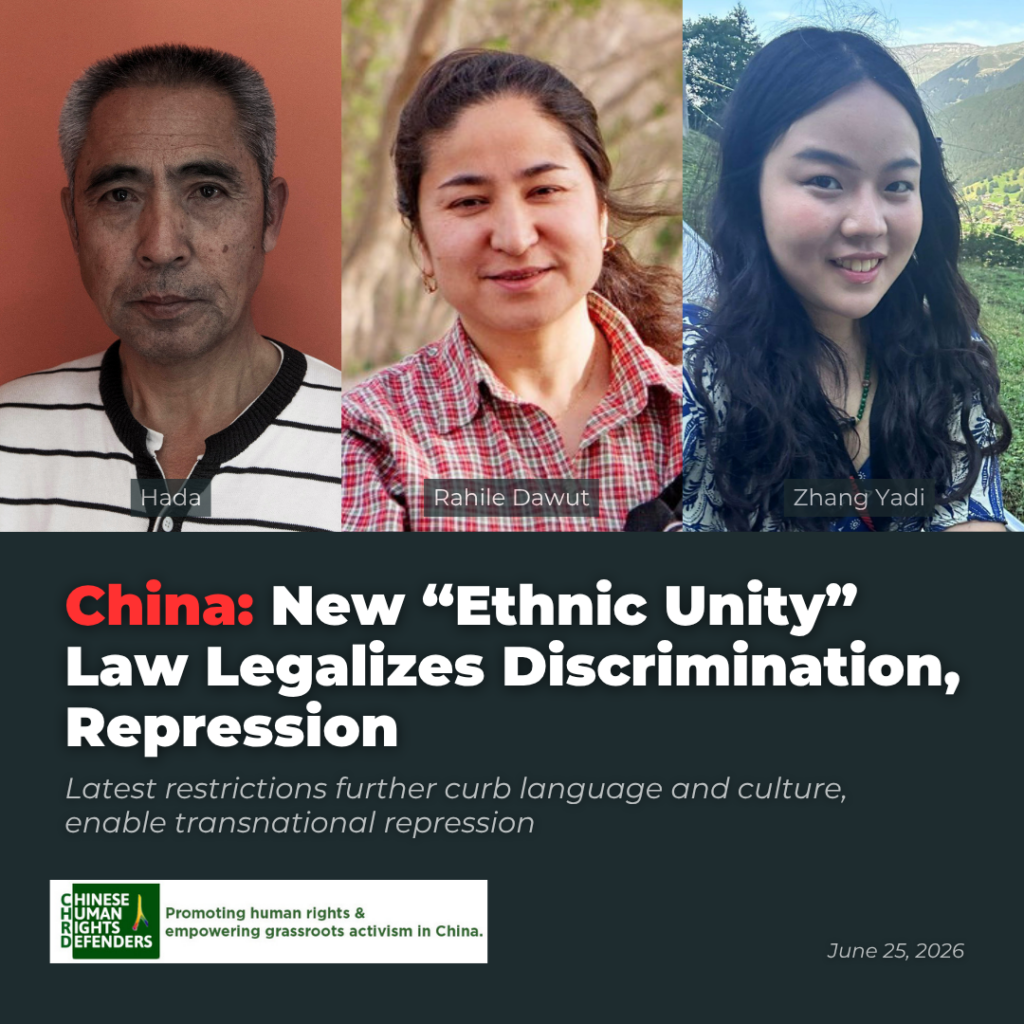
Recent cases show Beijing’s disdain for the rights of different ethnic and belief communities and advocates. A news story published in May 2026 indicated that 97 Tibetans in Shigatse City in the Tibet Autonomous Region had been detained in 2025, reportedly for simply livestreaming in Tibetan. In July 2025, the Changsha Public Security Bureau detained Zhang Yadi, an advocate for Tibetans’ human rights. She is reportedly being held for “inciting subversion” at Changsha National Security Bureau Detention Center in Hunan Province, but her wellbeing and the status of any legal proceedings against her remain unknown.
Renowned Uyghur scholar and founder of the Xinjiang Folklore Research Center, Rahile Dawut, is serving a life sentence for “separatism” after authorities subjected her to enforced disappearance in 2017. Authorities have yet to make publicly available credible evidence to substantiate the charge, and Rahile Dawut’s prosecution has been riddled with violations of fair trial rights.
Hada, a writer and advocate for Mongolian identity and culture, was subjected to enforced disappearance from his hospital bed in February 2025. He had previously served 15 years in prison from 1995 for promoting Mongolian culture, and was subjected to round-the-clock surveillance following his release.
Chinese authorities have escalated persecution of religious groups outside state-sanctioned institutions, including house churches, Catholics, Muslims, Tibetan Buddhists, and Falun Gong practitioners. The new law gives authorities another tool to deny religious freedom.
Having already tightened restrictions through revisions of the Law on the Standard Spoken and Written Chinese Language in 2025, Article 15 of the ‘ethnic unity’ law further requires schools and other educational institutions to use Mandarin Chinese as the basic language for teaching. The article includes provisions that could potentially penalize parents for educating their children about their own minority culture, language, or religion.
Freedom of religion and belief is further undermined while Article 46 of the law requires religious groups, schools and activity sites to “persist in the direction of Sinicization of [China’s] religions”—an unclear directive that leaves practitioners at risk of arbitrary investigations and prosecutions.
The law’s reach extends beyond China’s borders. Article 63 codifies transnational repression, stipulating that individuals or groups outside the country may be held legally liable if deemed to “undermine ethnic unity and progress or create ethnic division.” On June 24, 2026, China’s Vice Minister of Justice, Hu Weilie, stated that enforcing the law’s overseas provisions is intended to “safeguard China’s sovereignty and security.” Governments, human rights groups, and journalists have in recent years documented dozens of cases in which Chinese authorities have harassed and intimidated civil society organizations advocating for the rights of ethnic and religious communities.
The Chinese government has consistently failed to meet its obligations under key international treaties it freely ratified. It is more than three years overdue in reporting to the Committee on the Elimination of Racial Discrimination. In June 2026, the Committee on the Rights of the Child initiated proceedings for China’s next review; the last under this treaty was conducted in 2013, and the subsequent periodic report was submitted four years late.
Rather than bringing domestic laws and policies into conformity with international standards, the government recently announced its latest National Human Rights Action Plan (2026–2030). This document claims to respect ethnic minorities’ rights while offering no concrete policies to achieve that outcome.
“What is concrete is Chinese authorities’ effort to create a veneer of legality for discrimination and repression,” Yi said. “If the government is serious about ethnic unity, it should drop this law and allow accountability for vast violations.”
For more information, please contact:
Sophie Richardson, Co-Executive Director, Chinese Human Rights Defenders,
sophierichardson[at]nchrd.org, +1 917 721 7473
Shane Yi, Researcher, Chinese Human Rights Defenders, shaneyi[at]nchrd.org