


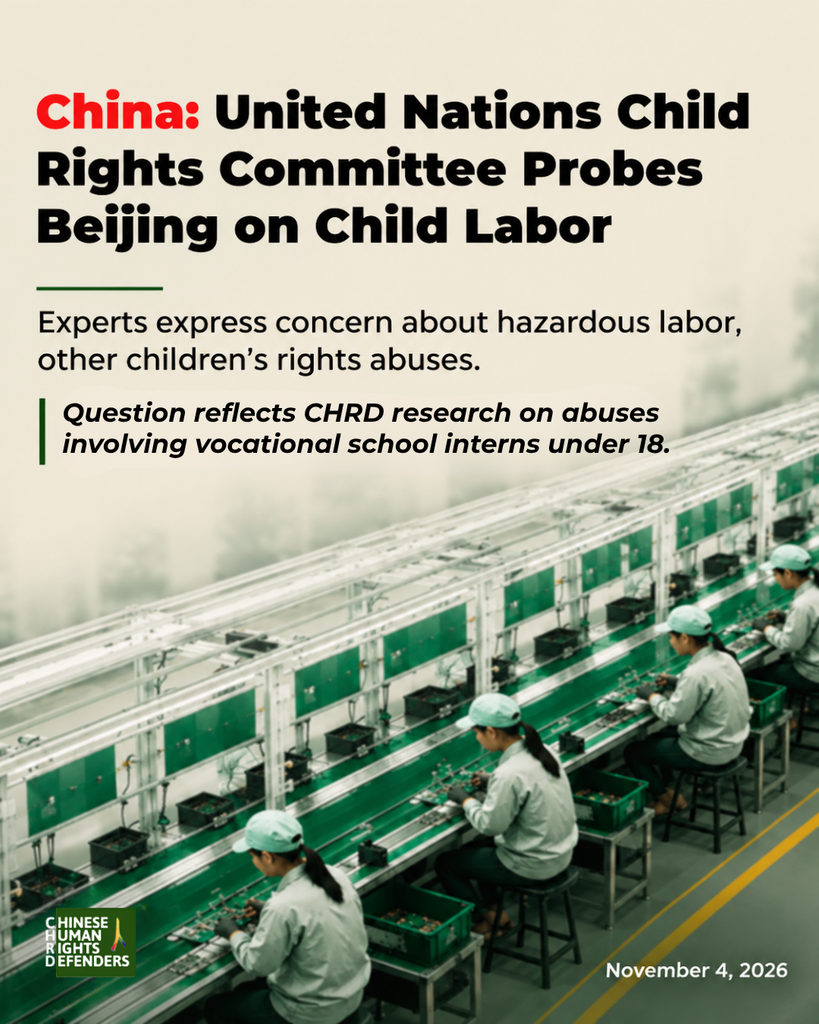
China: United Nations Child Rights Committee Probes Beijing on Child Labor
Comments Off on China: United Nations Child Rights Committee Probes Beijing on Child Labor
Experts express concern about hazardous labor, other children’s rights abuses
(Network of Chinese Human Rights Defenders—November 4, 2026) The United Nations Committee on the Rights of the Child has asked the Chinese government to explain how it protects children aged 16 to 18 from hazardous labor. The question, which is included in the formal List of Issues adopted by the Committee on October 2, 2026, reflects CHRD research documenting abuses of vocational school student interns under 18.
The Committee has provisionally scheduled China’s review under the Convention on the Rights of the Child (CRC) for its May 2027 session. The Chinese government is expected to respond to the Committee’s questions in writing by February 15, 2027.
The List of Issues covers a wide range of children’s rights concerns. The Committee asked the Chinese government critical questions about abuses including discrimination against Tibetan and Uyghur children, restrictions on their religious and linguistic rights, barriers to education, family separation, and reprisals against children who speak out. It also asked about the implications for children of laws adopted since China’s last review in 2013, including Hong Kong’s national security laws and the Law on Promoting Ethnic Unity and Progress, in effect since July 1, 2026.
The Committee asked the Chinese government to report on the measures it has taken to protect children aged 16 to 18 from “hazardous labor” and “to end forced, exploitative and hazardous child labor,” including in “schools, State-run work-study programs,” in manufacturing, and in Chinese businesses abroad. The experts also asked for information on investigations carried out, prosecutions brought, and sentences handed down in cases of forced and hazardous child labor.
Both questions draw on CHRD’s submission to the Committee, based on the report Genuine Free Choice? Child Labor and Mandatory Student Internships in China, published in May 2026. That research focuses on two overlapping issues: abuses within mandatory vocational school internship programs affecting students under 18, and the illegal hiring of children under 16. Despite domestic legislation and China’s ratification of the CRC and key International Labour Organization (ILO) conventions, abuses of child labor persist across industries.
Documented rights abuses in 11 provinces between 2019 and 2025 show some vocational students’ internships involved working 10–12-hour shifts, including night work, and performing tasks unrelated to their studies. Other internships put students at risk of physical harm. Three student interns died—two by suicide, one after being denied adequate medical care—and another harmed himself; all had expressed distress to teachers or managers, directly or through their families.
CHRD’s findings call into question Chinese authorities’ willingness to enforce domestic laws, including the Law on the Protection of Minors and the Regulations on the Management of Vocational School Student Internships, to protect children. The violations also reflect non-compliance with the Chinese government’s obligations under the CRC and ILO conventions.
Chinese authorities should make child labor data publicly available—including complaints received through the national hotline and labor inspection findings on hazardous child labor—and investigate labor dispatch agencies that unlawfully broker student interns. Reporting channels independent of school administrations are also needed, so that students do not fear that reporting abuse, or withdrawing from an internship, will jeopardize their ability to graduate.
Beijing’s written replies to the List of Issues, and its dialogue with the Committee in May 2027, will show whether the Chinese government is finally prepared to offer the transparency and accountability it has withheld for more than a decade—including for the children harmed in state-sanctioned internships. CHRD will monitor the Chinese government’s replies and continue to engage the Committee before the review.
For more information, please contact:
Sophie Richardson, Co-Executive Director, Chinese Human Rights Defenders,
sophierichardson[at]nchrd.org, +1 917 721 7473
Shane Yi, Researcher, Chinese Human Rights Defenders, shaneyi[at]nchrd.org