


China: Tiananmen Anniversary Highlights Systemic Labor Rights Abuses
Comments Off on China: Tiananmen Anniversary Highlights Systemic Labor Rights Abuses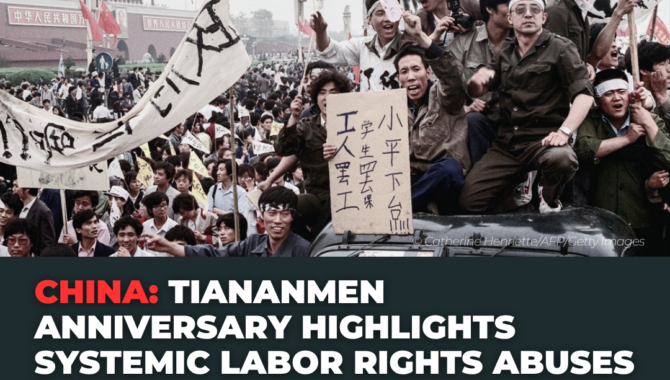
Workers a driver of 1989 movement but 37 years later abuses continue
(Network of Chinese Human Rights Defenders—June 2, 2026) Ahead of the 37th anniversary of the Tiananmen Massacre, CHRD pays tribute to the victims and survivors of the Chinese government’s violent military assault against unarmed protesters in 1989. Chinese authorities have never investigated or prosecuted perpetrators, and that impunity emboldens the current government’s atrocity crimes and human rights violations at home and abroad.
“Members of the current leadership believe they can get away with committing horrific abuses because their predecessors did in and after 1989,” said Angeli Datt, research and advocacy coordinator at CHRD. “As a result, Beijing’s victim list has extended beyond the workers and university students protesting then to include Uyghurs, Hongkongers, and diaspora communities, among others, now.”
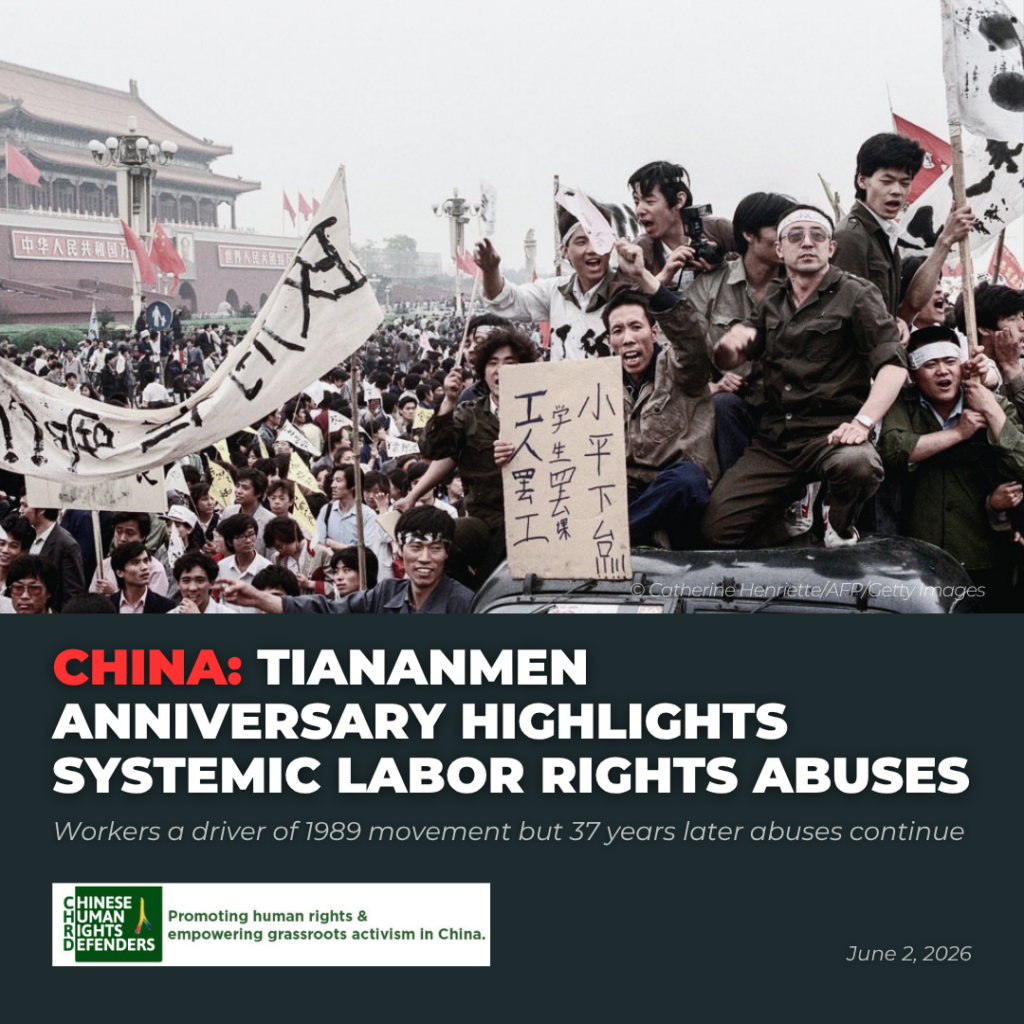
In April 1989 in Beijing, groups of students, workers, academics, and other citizens began protesting. Workers were a key driver of the movement, founding a short-lived independent trade union, the Beijing Workers’ Autonomous Federation, during the demonstrations. The protesters broadly called for political and economic reform, including democratization, the end of government corruption, better pay and working conditions, the right to strike, and the right to form independent unions. On the night of June 3-4, 1989, soldiers from the People’s Liberation Army moved into Beijing to crush the demonstrations.
In the nearly four decades since, authorities have persecuted victims, their families, and others who sought to remember the events of June 4th. In 2025, CHRD documented over 30 human rights defenders (HRDs) who remain detained for participating in or commemorating the events of June 4th. Activist Guo Feixiong, who was a student protester in 1989, has been serving an eight-year sentence on charges of “inciting subversion of state power” since 2023.
Since 1989, China’s economy has grown rapidly, becoming the second largest in the world—a transformation that rests in part on the relentless denial of the rights for which workers and other called for during the Tiananmen movement. Beijing’s hostility towards labor rights defenders, the right to freedom of association, and accountability for the Tiananmen Massacre are starkly reflected in Hong Kong authorities’ politicized prosecution of union leader and prodemocracy activist Lee Cheuk-yan. He is being tried on charges of “incitement to subversion” for helping lead the annual Tiananmen candlelight vigils in the territory until those gatherings were banned in 2020. He faces a possible 10-year prison sentence.
Chinese authorities’ disdain for domestic and international labor rights commitments extend beyond persecuting individual defenders. New CHRD research published in May 2026 found that the Chinese government, schools, and companies are failing to protect some children under 18 from hazardous work conditions and children under 16 from illegal employment. CHRD documented rights abuses in 11 provinces between 2019 and 2025. Some internships involved working long shifts, including at night, performing tasks unrelated to their studies that put students at risk of physical harm. Three student interns died—two by suicide and one after being denied adequate medical care—after having expressed distress to teachers and managers. Some companies hired children as young as 13. In July 2024, the local government in Dongguan, Guangdong Province, issued 39 administrative penalty notices to companies related to child labor.
In January 2026, several independent United Nations (UN) human rights experts raised deep concern over “persistent pattern of alleged State-imposed forced labor involving ethnic minorities across multiple provinces in China.” Forced labor of Uyghurs occurs through so-called “poverty alleviation” labor transfer programs. The UN cited Chinese government estimates that there were 13 million instances of these labor transfers in the Uyghur region between 2021 to 2025.
Independent trade unions are prohibited by law in mainland China. When the Chinese government ratified the International Covenant on Economic, Social and Cultural Rights (ICESCR) in 2001, Beijing made a reservation, rejecting Article 8, which enshrines the right to form and join trade unions of one’s own choice. Independent trade unions existed in Hong Kong for decades until Beijing imposed the National Security Law on June 30, 2020. News agency Reuters’ 2021 tally found that at least 29 trade unions dissolved in just over a year, including the Hong Kong Confederation of Trade Unions (HKCTU). Its membership had been one of territory’s largest, with over 100,000 members.
CHRD urges the Chinese government to remove its reservation regarding Article 8, quash all prosecutions of HRDs, including labor rights activists and people who participated in or commemorated the events of 1989, suspend mandatory vocational internships until students’ human rights can be guaranteed, and end the forced labor of Uyghurs. Chinese and foreign companies should comply with the 2011 UN Guiding Principles on Business and Human Rights by conducting and publishing regular human rights due diligence to identify and remedy harms committed or exacerbated by their operations.
“Ending labor rights violations and redressing the Tiananmen Massacre are inextricably linked: both depend on respect for the rights of free expression, assembly, and association,” Datt said. “Until that happens, consumers, investors, and governments have to face the reality that their commercial interactions with this economic behemoth contribute to—and sustain—the harms of June 4, 1989.”
For more information, please contact:
Sophie Richardson, Co-Executive Director, Chinese Human Rights Defenders,
sophierichardson[at]nchrd.org, +1 917 721 7473
Angeli Datt, Research and Advocacy Coordinator, Chinese Human Rights Defenders, angelidatt[at]nchrd.org, +1 934 444 6155
Shane Yi, Researcher, Chinese Human Rights Defenders, shaneyi[at]nchrd.org