


China: Impunity Persists for Nobel Laureate’s Death in Detention
Comments Off on China: Impunity Persists for Nobel Laureate’s Death in Detention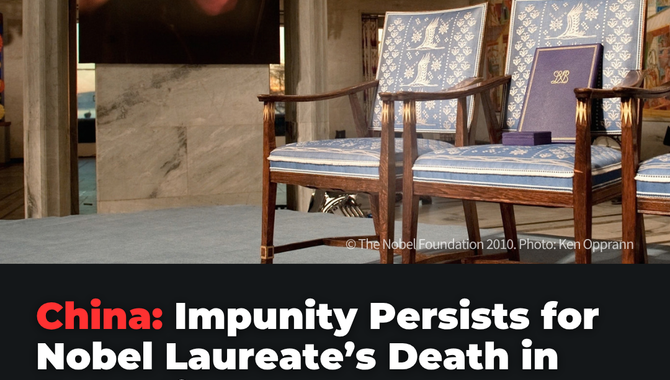
On anniversary of Nobel announcement, no accountability for his death in custody
(Network of Chinese Human Rights Defenders — October 8, 2026) Sixteen years after the announcement of Chinese literary critic Liu Xiaobo’s Nobel Peace Prize win on October 8, 2010, no Chinese government official has been investigated or prosecuted for Liu’s wrongful detention or for his death in detention stemming from denial of access to adequate medical care.
In addition, no official has been held accountable for the collective punishment inflicted on Liu Xia, his partner, following Liu Xiaobo’s detention and death. Chinese authorities continue to silence other human rights defenders for their public remembrances of Liu Xiaobo and his work.
Liu Xiaobo was a Beijing-based writer, public intellectual, government critic, and human rights defender. He was one of the lead authors of “Charter 08,” a pro-democracy appeal published on December 9, 2008. Police took Liu into custody the day before the document was published, on suspicion of “inciting subversion of state power,” and held him for a year before formally charging him on December 10, 2009. At his trial, authorities barred Liu Xia and diplomats from more than a dozen countries, including Australia, Canada, New Zealand, Sweden, the United Kingdom, and the United States, from observing the proceedings, and the court did not allow Liu to deliver his final statement. On December 25, 2009, the Beijing No. 1 Intermediate Court sentenced him to 11 years in prison, to be followed by two years of deprivation of political rights.
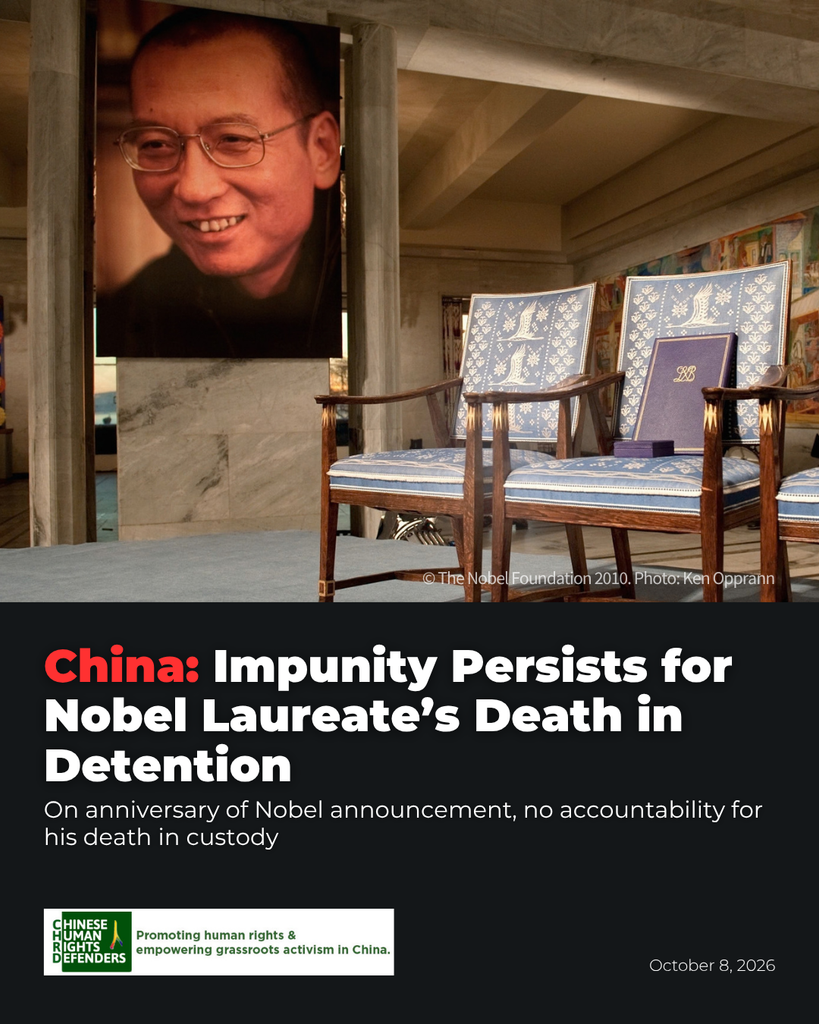
On October 8, 2010, the Norwegian Nobel Committee announced Liu as the winner of that year’s Peace Prize “for his long and non-violent struggle for fundamental human rights in China.” On October 11, authorities placed Liu Xia under house arrest in Beijing without any legal basis, cutting off her freedom of expression and movement. No family, friends, or activists were allowed to leave China to attend the Nobel ceremony in Oslo on December 10, where Liu Xiaobo’s final court statement, “I Have No Enemies,” was read in place of the laureate’s traditional Nobel lecture. His prize was placed on an empty chair.
In June 2017, Liaoning prison authorities suddenly announced medical parole for Liu Xiaobo, then held in Jinzhou prison, stating that he was suffering from late-stage liver cancer, and subsequently transferred him to a hospital in Shenyang. His contact with friends and supporters was severely restricted, and his request to seek treatment abroad was denied. Liu died in state custody on July 13, 2017. Chinese authorities responded by detaining supporters commemorating his death, and Liu Xia was forced to endure another year of house arrest before being allowed to leave for Germany in July 2018.
Since that time, Chinese authorities have repressed efforts to commemorate Liu’s life and work. Most recently, in February 2026, a court in Hangzhou sentenced human rights defenders Zou Wei and Zan Aizong three and a half years and three years respectively, on allegations of “picking quarrels and provoking trouble”—a vague charge United Nations human rights officials have called on Beijing to repeal—for merely gathering to remember Liu Xiaobo.
Liu’s case epitomizes well-documented, systemic human rights violations, including arbitrary detention, enforced disappearance, denial of fair trial rights, and collective punishment. In September 2026, CHRD found that denying adequate medical care in detention is the most common form of torture used against prisoners of conscience in China.
CHRD urges concerned governments and United Nations offices to commemorate Liu’s life and work by pressing Chinese Communist Party General Secretary Xi Jinping and other senior Chinese government officials at every opportunity for credible investigations of all officials responsible for violations of the human rights of Liu and his family and supporters.
For more information, please contact:
Sophie Richardson, Co-Executive Director, Chinese Human Rights Defenders, sophierichardson[at]nchrd.org, +1 917 721 7473
Shane Yi, Researcher, Chinese Human Rights Defenders, shaneyi[at]nchrd.org